How AI for Real Estate Investors Supports Lead Follow-Up and Qualification
The hard part of real estate investing is rarely finding a way to contact people. The hard part is staying on top of every conversation after that first touch.
Most investors learn this the expensive way. A campaign starts generating inbound calls, web forms, text replies, maybe a trickle of referrals. At first, it feels manageable. Then volume picks up. One seller reaches out during dinner. Another replies to a text at 6:15 a.m. A third finally answers after ignoring six previous attempts. By the end of the week, there are names in a spreadsheet, notes in a phone app, and half remembered conversations sitting in someone’s inbox. Deals do not usually disappear because the market lacked opportunity. They disappear because follow-up broke down.
That is where AI for real estate investors has become useful, not as a magic replacement for acquisitions work, but as a system for speed, consistency, and organization. When used well, real estate AI helps investors respond faster, qualify earlier, and keep lead nurturing moving without forcing every touchpoint to depend on one person’s memory.
Why follow-up is where investor lead generation often fails
Lead generation gets most of the attention because it is easier to see. Skip tracing for real estate investors, property owner lookup, seller lead generation, real estate prospecting, text message marketing real estate campaigns, PPC traffic, and direct outreach all produce visible activity. Phones ring. Forms fill. Texts come in. It feels like progress.
But revenue in AI real estate investing does not come from raw lead volume alone. It comes from conversion over time. Motivated seller leads are rarely neat, ready, and fully qualified on the first interaction. Some owners are curious but uncertain. Some are distressed seller leads who want speed but need reassurance. Others are months away from acting. If your real estate follow up system depends entirely on manual effort, gaps start forming almost immediately.
I have seen the same pattern across investor operations of every size. A small wholesaler thinks a basic spreadsheet will be enough. A growing acquisitions team starts with one CRM but never sets up proper workflows. A larger shop generates off market property leads at scale, yet still responds too slowly when a hot lead calls after business hours. The result is familiar: inconsistent seller lead follow up, delayed callbacks, poor note keeping, and too many leads that feel cold simply because nobody stayed in front of them.
Real estate automation solves that operational problem better than it solves any marketing one. Its real value is discipline.
What AI actually does in the follow-up process
There is a tendency to talk about AI as if it is one thing. In practice, it is several related tools layered into real estate investor software.
At the front end, AI lead generation real estate systems may help sort or route incoming inquiries. In the middle of the funnel, AI lead follow up can trigger text replies, call routing, reminders, and ongoing nurture sequences. Further down, AI lead qualification can help determine whether a seller is likely worth immediate human attention, later follow-up, or disqualification.
That matters because not every lead deserves the same response cadence.
A seller who just filled out a web form saying they want to sell a vacant property this month should not sit in the same queue as an owner who vaguely replied “maybe” to a cold text two weeks ago. A real estate AI CRM or AI CRM for real estate investors can separate those situations faster than a manual workflow usually can, especially when volume rises.
The useful version of AI follow up is not flashy. It looks more like this in daily operations: a missed call triggers an immediate text back, an inbound lead gets logged inside a real estate investor CRM, an AI voice agent handles first contact after hours, and the acquisitions team sees which leads are warm enough to call personally the next morning. That is not science fiction. That is just better process control.
The role of conversational tools in seller qualification
Seller qualification has always depended on asking the same core questions in a consistent way. Why are they selling? How soon do they need to move? What is the property condition? Who is on title? Are they open to a discounted cash offer? The exact script changes by strategy, whether you focus on wholesale real estate leads, buy and hold, or fix and flip, but the logic stays similar.
This is where voice AI for real estate investors and AI seller conversations can help. A properly configured AI phone agent real estate workflow can engage leads when a human team is unavailable, gather basic qualification details, and help book the next step. That makes a difference because real estate acquisitions does not happen on a convenient schedule. Sellers respond at lunch, late evening, weekends, and odd hours after seeing a message they ignored earlier.
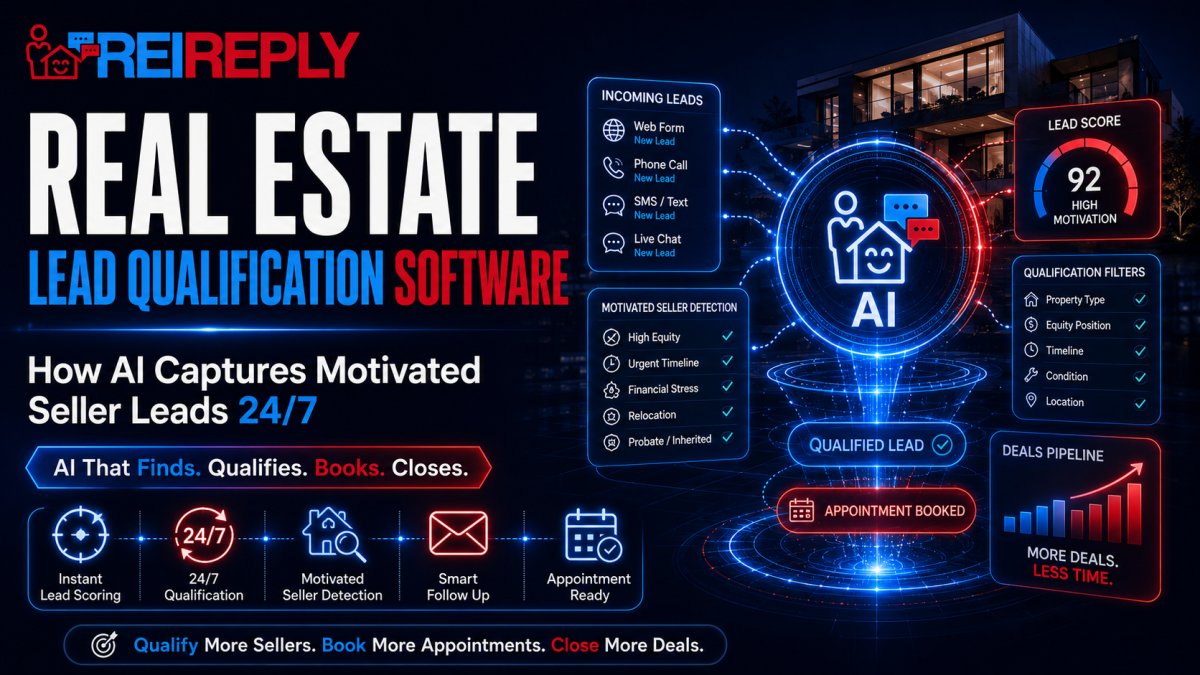
REI Reply is one example of how this category is being packaged for investors. Based on its public positioning, it is built specifically for real estate investors and combines inbound and outbound calling, SMS, missed call text back, and AI voice assistants in one platform. The company also states that it is meant for wholesalers, fix and flippers, buy and hold investors, and acquisitions teams running PPC, SEO, cold calling, or SMS outreach. That distinction matters. It presents itself not as a lead provider in the usual sense, but as a conversion engine for leads already being generated.
That framing is accurate to how many teams actually need to think about real estate investor automation. The issue is often not a total lack of leads. The issue is whether the business can absorb, respond to, and qualify those leads without leakage.
REI Reply also says its AI voice agent can qualify leads, book appointments, and follow up around the clock across calls, SMS, email, and social channels. If that works as intended for a given operation, the practical benefit is simple: fewer first touches are missed, and fewer potentially motivated seller calls die in voicemail.
Speed matters more than most investors admit
Investors sometimes underestimate how emotional seller timing can be. A homeowner may decide to inquire after an argument with a co owner, a problem tenant situation, a probate update, or a contractor estimate that came in too high. That motivation can be strong at 8:40 p.m. And much weaker by 10:00 a.m. The next day.
A fast response does not guarantee a deal, but a slow one routinely kills deals.
Real estate SMS automation has become popular for that reason. SMS follow up is immediate, familiar, and less intrusive than a phone call for many sellers. Automated SMS for real estate investors can acknowledge an inquiry right away, confirm receipt, and keep the conversation moving until a human takes over. For investor teams using real estate text marketing at scale, this is often the difference between organized lead management and reactive chaos.
Still, there is a trade-off. Automated text messaging can create the illusion of engagement without producing real progress if the messages are too generic. Sellers can tell when they are trapped in a loop. They may still respond once, but they are less likely to trust the process. So the best automated seller follow up is structured, but not robotic. It should move toward useful information, not just “checking in” every few days with no context.
Some platforms now market text deliverability features and message variation tools meant to help investor texting feel more natural. REI Reply, for example, advertises workflow features that include AI conversations, lead management, automated follow-up, and messaging tools such as Spintax and Humanizer oriented toward text deliverability. That may help operationally, but it does not remove the need for sound judgment. Better wording can support real estate SMS deliverability, yet irrelevant or poorly timed outreach is still poor outreach.
Good qualification is triage, not interrogation
A lot of acquisitions teams make qualification harder than it needs to be. They try to gather every possible detail on the first call or text exchange, even when the seller has not earned enough trust to provide it. That approach slows things down and creates friction.
Better real estate lead qualification works like triage. It sorts leads into action categories. Hot now, nurture later, probably not a fit, maybe worth revisiting. AI lead management can support that sorting if the rules are clear.
A practical qualification flow usually hinges on a few signals:
- Seller motivation and reason for selling
- Expected timeline
- Willingness to discuss price or terms
- Property condition or complexity
- Readiness for an appointment or direct acquisitions call
Those signals are enough to direct the next step. They are also broad enough for automated lead qualification to capture without overcomplicating the first interaction.
This is especially useful when working with motivated seller text messages or inbound calls from campaigns that produce mixed intent. Some leads will never become deals. Some should be nurtured for months. Some need a same day callback from a closer. If your real estate sales pipeline treats all three the same, your team burns time where it should not and neglects opportunities where it should not.
The CRM matters more than the script
Every investor wants the perfect script. Few spend enough time on the system holding the conversation together.
The best CRM for real estate investors is usually not the one with the fanciest dashboard. It is the one that keeps every contact, message, appointment, and follow-up task in one place so the team can act without guessing. That is why investor focused platforms tend to matter. General purpose CRM tools can work, but they often require heavy customization before they resemble a motivated seller CRM or a true real estate AI CRM.
Investor teams need a place where property data, owner details, communication history, and pipeline stage live together. They also need automated lead follow up that reflects the way real estate investor leads behave, which is rarely linear. A seller may ghost you for three weeks, reappear through an inbound call, then go quiet again until a life event pushes them back to the table.
REI Reply’s positioning speaks directly to that reality. It describes itself as built specifically for real estate investors and includes multichannel communication tools inside the same platform. It also says a subscription includes access to verified motivated seller data through REI AI Leads. For a team trying to unify real estate lead generation, real estate lead management, and seller lead automation, that kind of consolidation can reduce the usual problem of software sprawl.
Of course, consolidation alone does not fix a broken process. If no one defines when a lead becomes qualified, when a human should step in, or how long a nurture sequence should run, even the best real estate automation software turns into a messy message machine.
Where compliance becomes a real business issue
Real estate SMS marketing and AI calling real estate workflows only work if messages and calls actually get through, and if they are being sent legally.
This is where many investors get careless. They think about outreach volume before they think about business texting compliance, opt out handling, or call timing. That is risky. The FTC says telemarketers must honor Do Not Call rules, cannot use the National Registry or company specific DNC lists for any purpose other than compliance, and generally may not call outside 8 a.m. To 9 p.m. Local time without prior consent. The FTC also says prerecorded telemarketing calls require prior signed, written agreement, and that consent can be obtained electronically if https://rentry.co/hkfx6ycm E-SIGN requirements are met.
For real estate investors using AI voice agent workflows or broad outbound calling campaigns, those rules are not side issues. They are operating rules.
Texting has its own infrastructure realities. A2P 10DLC is the U.S. Carrier standard for application to person SMS traffic sent through 10 digit long code numbers, designed to ensure messages are verified and consensual. Investors who rely on SMS for real estate investors, bulk SMS real estate, or automated real estate texting ignore this at their own expense. Poor registration or poor practices can affect SMS deliverability real estate campaigns depend on.
If you are sending serious volume, your team needs to treat A2P 10DLC registration, SMS marketing compliance, and real estate texting compliance as part of setup, not as an afterthought once carrier filtering starts hurting response rates.
Why data quality still sets the ceiling
No amount of AI follow up can rescue bad contact data.
If your property owner data is stale, your real estate skip tracing output is inaccurate, or your motivated seller data is low quality, automation simply helps you scale mistakes. Investors sometimes confuse activity with progress. They launch seller text messaging, automated SMS, or voice outreach to large lists, but the underlying records are weak. Then they blame the CRM, the copy, or the channel.
Good real estate investor data remains foundational. Whether you are trying to find off market properties, skip trace property owners, or build real estate lead lists for prospecting, your contact information determines how far automation can take you. AI lead generation real estate systems can improve handling and prioritization, but they cannot make wrong numbers become right ones.
That is also why lead qualification should not be reduced to software scoring alone. A distressed property lead with sparse data might still become a great deal if the human follow-up is timely and skilled. On the other hand, a neatly scored lead with weak motivation may consume hours and go nowhere. Judgment still matters.
What a strong workflow looks like in practice
The most effective real estate follow up automation usually feels boring from the inside. That is a good sign. It means the system is doing its job.
A seller comes in through a web form, an inbound call, or a response to real estate investor texting. The system logs the lead, triggers an immediate acknowledgment, routes the conversation based on timing and channel, captures early qualification details, and flags whether an acquisitions rep should take over now or later. If nobody answers a call, a missed call text back keeps the contact warm. If a seller is not ready today, a nurture track maintains light contact without forcing a rep to remember every follow-up manually.
That is the operational promise behind AI real estate assistant tools, AI acquisition assistant workflows, and real estate marketing automation more broadly. They reduce the amount of lead handling that depends on human memory while preserving human effort for the moments that actually require persuasion, negotiation, and trust.
The teams that benefit most are usually not the ones chasing novelty. They are the ones already generating enough lead flow that every missed call, every delayed response, and every forgotten follow-up carries a real cost.
The real advantage is consistency
There is a reason the conversation around AI for real estate wholesaling, wholesaling automation, and real estate acquisition software keeps getting louder. Investors do not just need more leads. They need a repeatable way to work the leads they already have.
Consistency beats intensity here. A team that follows up well, qualifies cleanly, and keeps every lead in a visible pipeline will usually outperform a more aggressive marketer with weaker systems. That has been true long before real estate AI showed up. AI simply gives investors better tools to execute the basics without as much operational drag.
So when people ask whether AI for real estate investors is worth it, the better question is narrower. Does it help your business respond faster, qualify earlier, and maintain contact without losing control of compliance or conversation quality? If the answer is yes, then the value is not theoretical. It shows up in fewer missed opportunities, cleaner lead management, and a steadier path from first touch to signed agreement.
That is what lead follow-up was always supposed to be. AI just makes it easier to do it well, every day, even when the phones are still ringing after your team has gone home.